Welcome to my world!

Welcome to my world!
Showing posts with label sacred spaces. Show all posts

Tuesday, March 31, 2015

Shingon Shu Hawaii Mission: Esoteric Visions, Sacred Lines

There it was. Well, not quite as I remember it. For years I've walked by the Shingon Shu Mission in Honolulu, yet I had no idea it was there. 


The plain, unadorned back of the temple faces Keeaumoku Street, also known locally as Korea-moku Street due to the proliferate number of Korean restaurants and business establishments. The street is also home for what is reputably the world's largest Walmart store -a retail battleground we commonly refer to as the nuthouse.

I had been on a visit to Makiki Christian Church to capture images of its alluring Japanese Edo-era castle interior and exterior features. It was a nice day in Honolulu -well, isn't everyday a nice day here weather wise? I decided to trek through the nearby neighborhood streets. 

That's when -much to my delight and surprise- I encountered this:


Meet Kūkai, known posthumously as Kōbō Daishi (774-835 CE), credited as the founder of Shingon (True Word) Buddhism

It does not get much more dramatic than this. That was fine with me. I love a good surprise! Some of my most interesting adventures into the esoteric spaces and places of worship by humanity's array of religions and beliefs were happenstance. 

You'd be amazed to find that this oasis of mystical Buddhist piety is located in one of the busiest crossroads of the city of Honolulu. A McDonald's is located a stone's throw away -and yet the placidity and otherworldliness of Shingon Shu Mission was so evident. The juxtaposition of the temple with the world's most-recognized fast-food establishment could not be more accentuated. 

With time to spare and camera in hand I decided to vanish from the outer world's noisy clamor and explore this temple's captivating nuances. I was alone to savor the tranquil flavors of this ornate temple off Sheridan Street. 


Located in Honolulu, Hawaii USA, this temple was originally built a century ago. Nakagawa Katsutaro was a master builder of such Japanese-inspired temples as this masterpiece of his works. 

Does the name Hego Fuchino ring a bell or two? Besides known locally as Hawaii's first American of Japanese ancestry to be a licensed architect, he designed nearby Makiki Christian Church. He was brought in to renovate Shingon Shu in 1929. 


Besides serving as a temple I later learned that Shingon Shu is a congregational Buddhist school immersed in following the original tenets established over 1200 years ago by Kobo Daishi. He is credited as bringing Buddhism from China to Japan in 806 CE. 

On April 26, 2002 this temple was added to the National Register of Historic Places. 

Two massive statues stand guard just outside the main entrance to the temple. Installed in 2007 and carved of Japanese cypress, the statues represent Fujin, the Wind deity, and Raijin, the Thunder deity. Standing more than ten feet tall, each weighs 2,800 pounds. They are the largest such depictions of these Japanese deities outside of Japan. 

Why were they added to the temple? Hawaii is famous for the prevailing trade winds from the north, making the islands a very comfortable locale all year round. Both deities represent the powers and forces of Nature. 


On the right side of the temple entrance is Raijin, the God of Thunder. Impressive! He could certainly give Thor the God of Thunder popularized by Marvel Comics some real competition. 


On the left is this remarkable representation of the deity Fujin


Do you see what Fujin is carrying on his shoulders? That, my friends, is a large bag of wind. I wondered if the etymology, or phrase origin of the term windbag had something in common here? Have you called anyone a windbag recently? Or, been called one?

Never mind. Let's continue. I'm in enough trouble as it is. 


This exterior altar caught my eye. It is located to the left of the main entrance to the temple.


This obelisk is located near the front entrance of the temple. It is dedicated to the first Shingon mission from Japanese immigrants in the Hawaiian Islands to Japan in 1929. 


For as long as I can remember I have been enamored with the sheer elegance, refinement and sophistication of hip-and-gabled roofing style so graciously synonymous with East Asian architecture. In Japanese this is called irimoya. 

I was also quite charmed and fascinated by the intricate carvings above the main entrance. I leaned, too, that the curvature seen above symbolizes the cycles of life. 


The carved Phoenix immediately above the entrance caught my eye. In a time when we are immersed in instant-downloads to our curiosity such a masterstroke of expression reminded me that the best in life comes as a result of both effort and patience. 


The late-morning sun was beating down heavily that day. Naturally,  I sought comfort and relief inside. Again, I was alone with my camera and my thoughts. I would not be disappointed upon entering the main hall. 


The colorful, glittering altar proportionally coupled with the ceiling mandala and the Japanese-built benches around me made for a pleasant balance. Esoteric indeed. 


I will not endeavor to pretend to know all of the symbolism of the altar. It did strike me as beautiful, ornate, and contemplative. A Buddhist friend I subsequently wrote to about my experience at Shingon Shu Hawaii and my (hopefully not-too-annoying) questions would later comment:

"Yes, when I visit temples like Shingon Shu I bow, savor the atmosphere provided by the candles and the incense -and what it does is transform my state of mind. You've spoken about how calming it is to enter the sacred spaces that typify your Christian journey. It's the same here. I feel centered, blessed and renewed by my awareness in a quiet, delightful way. I'm still on the road to enlightenment, so this is a nice part of that continuous voyage." 

The 600 square foot or 56 square meter taizokai mandala suspended from the ceiling is remarkable in its vibrancy and detail. This, I would learn later, is a recent addition to the temple. 


This is not a bell but rather a Bonshō. In Japanese Buddhist temples that are struck from the outside with a mallet or a wooden beam suspended on ropes. The are traditionally made from bronze, and I believe that this is the case here. Each of these is amplified by ornate, ornamental inscriptions and designs. This one hangs from the right-side exterior of the temple. No, I did not make an attempt to ring it. 


Eleven years ago in 2004 Shingon Shu made history by separating from its denomination in Japan. The Hawaii Herald featured news of this move in this June, 2004 article. By "sailing its own canoe," the Mission is embarking on a new independent course with its precedent set centuries ago in the continued history of Buddhism. 

My own faith journey is Christian in the Congregationalist Protestant tradition, yet here in Hawaii I count many of my neighbors and friends as practicing Buddhists. We're kind to each other, our neighbors here in the Land of Aloha -and with that sentiment renewed again I wished them well. 

It was time for me to move forward, to return to the hectic pace of contemporary living, including all its headaches and responsibilities. Pretty soon the summer sun would descend on this haven of balance and beauty -and the festive season of bon dances. I just might stop by again to check up on my neighbors. Will future seasons and centuries see the emergence of a form of Aloha-based Hawaiian Buddhism spawned from its Japanese roots? History will unfold as it should. 


Thursday, October 2, 2014

Hawaii's Broken Ridge Temple: A Sacred Buddhist Refuge for Those Who Seek Escape

There is something surprising and bold about Honolulu's Broken Ridge Temple deep in Oahu's Palolo Valley.

As sacred spaces and architecture goes, it really throws a little water in your face when you see it for the first time. I had heard about this temple for years from friends and some of its neighbors -who were less than complimentary at the time. I'll explain in a few moments.

It had been a particularly hot, balmy day in Hawaii. I have a hard time explaining to people that September is the hottest time of the year here. Any of you who rise before dawn and settle down after dusk working on developing your business passions know what it feels like to suddenly want to stop. No amount of staring into a computer screen will change a thing. This does not happen often to me, yet when it does there's a signal inside that says that an escape from the everyday order of things is required to reboot.

When I get into these moods I am drawn to sacred spaces. Whether it is Thian Hock Keng in Singapore or the towering steeple of my ancestral Second Congregational Church in Greenwich, Connecticut, such masterpieces of physical architecture are impressive. I suppose what I like about them is than in a world worn by strife and stressful change there is a sense of stability and permanence. The intimacy that one can find in such environments can be calming to the soul.

The other dimension to all this is time. Years ago I had the pleasure of meeting renowned architect Paul Goldberger, who participated in an Architectural Lecture Series in my home town, Greenwich, Connecticut USA. In 2010, Golderberger delivered a lecture at the Chautauqua Institution in which he said:

It is difficult, perhaps impossible, to talk about sacred space without talking about time. One of the most important things about any sacred space is the way in which it transcends our normal sense of time, and by that I don’t mean that it has no connection to a time, but only that shows us with absolute clarity what the meaning of the word “timeless” is. 


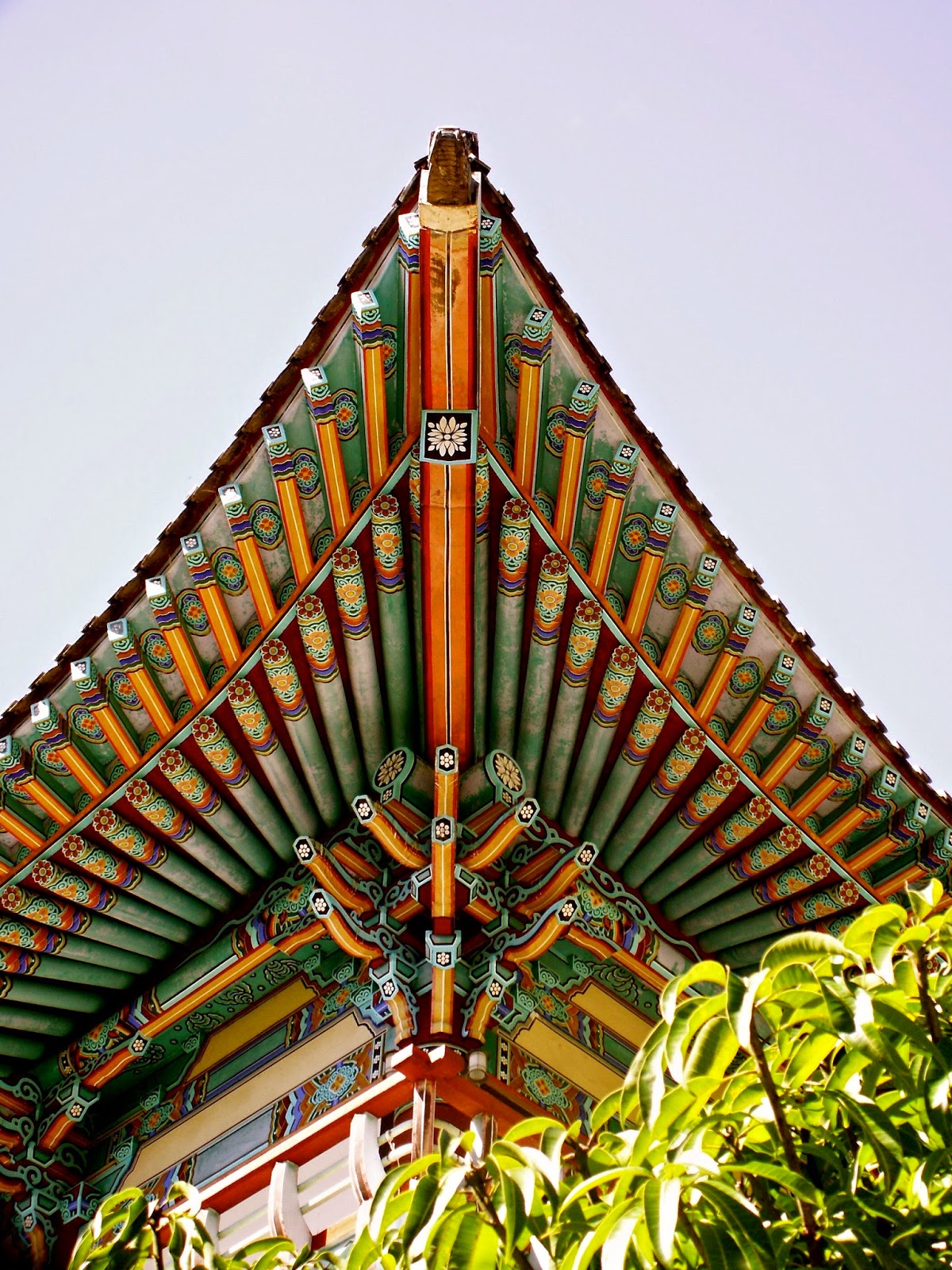
I was captivated by the traditional Korean Tanchong-styled designs upon the temple walls, columns and eaves.

Today I would be in for a timeless treat. Yearning for a fresh experience,  I decided to drive to Oahu's Palolo Valley and savor the tranquility I had heard so much about at MuRyangSa Temple, also known more famously as the Broken Ridge Korean Temple. 

I had little idea what to expect. 

Originally located off King Street in Honolulu back in 1975, that temple -known as Dae Won Sa- was destroyed in fire. The temple's campus was relocated to Palolo Valley in 1986, the same year construction commenced. Believe it or not this temple was not completed until 2005. 

Why?

Local residents filed legal disputes regarding construction through the courts. The roof of the main hall was reduced. 

The Buddhists are philosophical about this, saying:

As a result, the roof was lowered to its present height. In Buddha’s teachings, he speaks of shattering our inner ridge-poles of ignorance, greed, and craving in our “house of illusion.” The shattering of ignorance by wisdom results in the demolition of illusion and the attainment of liberation–or nirvana. As with the enlightenment of the Buddha, may the shattering of our own inner-roofs remind us of the structures of ignorance that can be let go to reach the true heights of our inner liberation.


Here's the entrance to the temple. What odd about this one? Can you see? Hint: look at the roof line on the left. That's why this is called 'Broken Ridge' Temple.


You are greeted by this Buddha statue. This is where you give your donation. No one is around to enforce this, so  they rely upon the honor system. 

On either side are the Four Heavenly Kings. The figures are quite tall and immense. Each of the Kings comes with his own symbolic significance and established position in Buddhist tradition. I was told that the King of the West holds a small pagoda, the King of the East carries a sword, the King of the North holds a pearl and a dragon, with the King of the South holding a lute. 


When you walk into the gateway of Broken Ridge Temple you are greeted by four rather large Heavenly Kings. Here are two of them. 


These are the other two. They sit. They stare. They glare. All four of these deities guard the four cardinal directions and the Dharma Hall. The word 'dharma' refers to cosmic law and order in Buddhism. I found their countenances a bit amusing, though I'd imagine the intention was to be a bit intimidating.

There are an interesting contrast between Christian and Buddhist briefs on evil. Christians traditionally tend to look beyond for evil or corrupting influences. On the other hand, I learned that Buddhists look within for such evil influences as the desire to do violence, to embrace greed, lust and the kind of pride that can be self-destructive. Those who seek enlightenment as pilgrims come to this place to find the path towards overcoming those baser dimensions of nature. The role of the Heavenly Kings is to keep out evil influences. 

One of the things I was struck by was the brilliance of the colors here -not just on the Heavenly Kings, but also the entire temple complex. Tanchong-style temples like this one in Korea are emblematic of an older, golden age and tradition. Trust me when I say that the colors and textures left me with quite an impression. 

The MuRyangSa Temple web site features detailed English language explanations for various elements of the temple complex. I wish each section of the text featured a picture of what it is referring to. It's worth a read-thru at the very least. Click here! 


This is the entrance gateway containing the Four Heavenly Kings and the Buddha statue above. The perceived smallness and dimensions of the building is a bit deceiving at first. What a contrast the brilliant colors have to the greenery of the rim of Palolo Valley beyond. 


When this temple was in its construction phase someone noted that the roof appeared a bit high. It was then realized that the temple was in danger of being in violation of established city building codes. What you see here was the solution. 

The monks who live and worship here make their own kim chee. This is how! I was not offered any. :(


I really was delighted to find peace and tranquility around every bend and corner. 


Every image and every detail was hand-painted. Simply gorgeous! Can you imagine the patience this takes to achieve? It is incredible. 


Yes, even the monks here have to relax. It's a splendid view. No, I did not try out the chair. 


Close enough and yet far away. This is a view from the temple towards Waikiki Beach and the vastness of the Pacific Ocean beyond. 

Broken Ridge Temple in Palolo Valley welcomes visitors daily from 9:00 a.m. to 5:00 p.m. There is no formal admission charge, but a general donation of US$3.00 is welcomed. For seniors aged 60 years or older $2.00 is recommended. Groups of five or more must be reserved in advance. 

The address: 2420 Halelaau Place, Honolulu HI 96816.

Honolulu's city buses do not come this far into the valley, so a motor vehicle is recommended. Parking is a bit of a problem. I park the car I used off campus on the street. There is a parking garage underneath the temple, so it is probably best to call first and inquire. 

Quiet time is always observed here. No photography is permitted inside the buildings as meditation is always in progress.