Welcome to my world!

Welcome to my world!
Showing posts with label Hawaii. Show all posts

Saturday, June 20, 2015

National Memories: China-USA World War II Collaboration at Hawaii's Pacific Aviation Museum

"The historic friendship between China and the United States in World War II was significant for the outcome of the war, and continues to resonate with citizens of both countries," said Shauna Tonkin, director of education of the Pacific Aviation Museum Pearl Harbor, "this exhibit portrays the events and emotions of that era through remarkable photographs that bring this history to life."


It's big. Really big. Larger than life comes to mind. Inspiring. It makes your spirit soar. 

Hawaii's Pacific Aviation Museum at Ford Island, Pearl Harbor offers a unique historical wow-factor like no other. I've been coming here since the museum opened on its first day in 2006. For me the closest thing to immersing myself in aviation up to that time was flying Economy-class on a commercial airline. 

But now? Oh! 

I'm a huge fan of this museum, a must-see for anyone visiting Hawaii's Pearl Harbor. I'm also a huge fan of that special-class of aviation historians and airplane afficiandoes. They talk-story about their flying machines and experiences with a special affection and reverence that brings a smile. 

Earlier this Spring I was sent news of a new exhibition that got my blood pumping. On March 15, 2015 National Memories, a photo exhibition like no-other focusing on the collaboration between the USA and China during World War II was opening. Its focus is on the China-Burma-India (CBI) Theater. When I was reminded that the exhibit was set to close on July 31.


(Click here for a link to Hawaii Governor Ige's official proclamation in recognition of the exhibit). 

I was bounded and determined to put any and all my commitments on the back-burner to see it. If I had to walk to Pearl Harbor so be it! Fortunately my already-worn running shoes and leg muscles were spared. 


That's the U.S.S. Missouri Memorial on the left; the conning tower of the Pacific Aviation Museum in the center; and the U.S.S. Arizona Memorial on the right. My visit to Pearl Harbor was on a picture-perfect day -a stark contrast to those on December 7, 1941 and thereafter. 


This is the restored conning tower at the Pacific Aviation Museum on Ford Island, Pearl Harbor Hawaii. 


The National Memories exhibit was in Hanger 79, a part of the Pacific Aviation Museum. 

This is the scene I beheld when I quietly strolled into Hanger 79. 

The sheer size of the hanging panels lends itself to what is so evidently true of those portrayed here. The Chinese and Americans worked side-by-side under horrendous circumstances to do the impossible -and as a result earned for themselves the larger-than-life reputation they so clearly deserved then as they do now. 


Many Americans today still think China is on the other side of the world.


This photo was a popular one among my fellow visitors. It shows an American soldier and a Chinese soldier leaning in each others' direction to light a cigarette during the fighting in Burma's Hukawng Valley: 

Click here for a link to the story published in China Daily. David Lampton, the former president of the National Committee on US-China Relations summed this image up by saying, "It showed a kind of cooperation. It's very humane... this is a good model for cooperation we should apply in the future, it also reminds us that there is no peace in Asia unless the United States, China and Japan get along, so we have to find a way to do that."


Dashing and daring, don't you agree? Meet Canadian-born Chinese Aviator Albert Mah. 


Dated May 1, 1944, "American-Japanese interpreters with Brig. Gen. Frank Merrill's Infantry troops in northern Burma. Left: T/Sgt. Herbert Miyasaki, Paauild, Hawaii. Right: T/Sgt. Akiji Yoshimura, Colusa, California. 


This was my favorite image of the exhibition. Meet 16-year-old Pvt. Pan Chen-to of the 1st Chinese Commandos. "The youngest paratrooper in the world... is smiling happily after making his first jump at Kunming, China. The paratroopers are being trained by American officers and men of the Office of Strategic Service." 


Another personal favorite of mine was this image. Dated June 25, 1942, it was all-smiles for Jean Lynch and Lt. Pao-Chuen Chung, Lt. Yuen-Kong Ling, Lt. Ming-Wei Chang, and Lt. Wen-Su Hsu. They were "at an eastern air base in New England [the states of Maine, New Hampshire, Vermont, Massachusetts, Rhode Island and my ancestral home, Connecticut] where they were receiving advanced aerial operation instruction" while enjoying "ice cream cones at the PX" by Miss Lynch. 


I found a familiar face among the photos! may I introduce you to U.S. Marine Cpl. Richard W. Miller? The Philadelphia native is shown here in this image dated September 30, 1945 is bargaining with a native of Tianjin (Tientsin) for a ride in the man's rickshaw. Miller is familiar to me through my late-father, Herbert Bingham Mead, who was stationed in Tianjin with the 1st Marine Division at the same time (See my historical blog site My Dad the U.S. China Marine). Miller was a Marine photographer who was serving with the occupation and repatriation troops there and in Beijing. 


On my way out I paused to gaze at these window panes. The bullet holes you see are from the December 7, 1941 attack by forces of the Empire of Japan. 

This was one of those exhibits that left me feeling inspired. It was all so historic, and yet so new. I also felt a tinge of validation about my own book project on the post-World War II American China Marines of which my father was one of them. Here were two very distinct peoples (Chinese and American) fighting together in a cause that brought out the best and the bravest. What I identified with most was the humanness of this exhibit. While the military historical overtones were obvious this what I witnessed on this visit was a human story. I loved it and, in all honesty, hated to leave. 

The exhibit was organized by the China Overseas Exchange Association, the Pacific Aviation Museum Pearl Harbor, Rhythm Media Group Inc. and the Chinese Chamber of Commerce of Hawaii. 

Please go to the Pacific Aviation Museum here in Hawaii soon. This exhibit concludes July 31. You will not regret it. I hope your spirits soar as mine did.

For more on this exhibit go to the following resources:

Photo exhibit on China-U.S. WWII collaboration unveils in Honolulu.  Xinhuanet Asia & Pacific Edition. March 15, 2015. 

Photos Record US-China Friendship During WWII. Global Times. March 19, 2015. 


National Memories: Sino-U.S. Cooperation During WWII. Beijing Review. Updated June 11, 2015. 

C-100 Supports Commemoration of U.S.-China WWII Collaboration. Committee of 100. October 15, 2014. 


Saturday, April 11, 2015

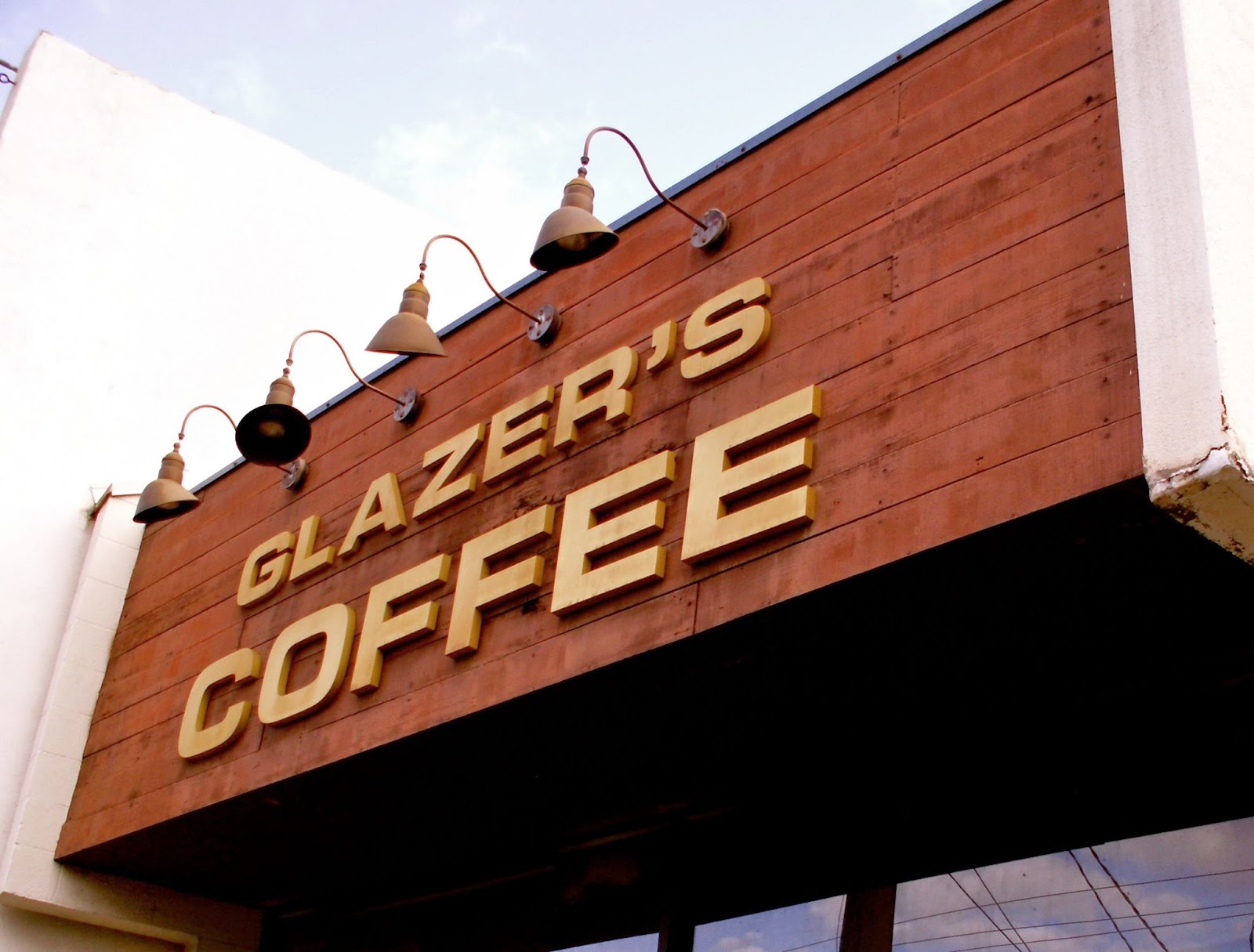
Stand By for Good Brews at Glazer's Coffee, Hawaii USA

It was a typical Saturday morning. The work week had been particularly hectic. My attempts to nail that "work-life balance" illusion-thin was exactly that -illusionary and illusive. I just knew one thing:

I was dying for a cup of coffee, in a mug, with a touch of relaxed ambiance that was close by. That place on this Saturday morning would be none other than Glazer's Coffee in Honolulu. 


Please let me in! Ha ha ha! The line was forming as early as 7:30 a.m. for our Saturday morning coffee fix at Glazer's. 
I was invited by a good friend of mine and of Hawaii's legal community. William Stempel is Hawaii's Law Librarian and a local resident of the Moiiliili district of Honolulu. He recommended Glazer's as the change-of-pace I was looking for. We arranged to meet on Saturday morning. 


Glazer's Coffee is located in the Moiiliili section of Honolulu, not far from the main campus of the University of Hawaii at Manoa. 

We arrived early to find ourselves in company with brave, early morning college students who, like me, were craving our coffee-fix. 


Would I define this as a "hole-in-the-wall" coffee shop? Glazer's Coffee fronts a very busy stretch of South King Street. 


That's Hawaii's law librarian William Stempel who first introduced me to Glazer's Coffee. He brought his morning newspaper, while I came with laptop in tow for another day of writing, blogging and some work. My first impression was how relaxed and mellow this place was. 


Glazer's reputation as "hipster" and "artsy" was confirmed by the atmosphere of the shop. So far, so good. 


 Glazer's offers caffeine-depraved souls like me a diverse selection of coffees. This includes hot or cold expressos, lattes, and teas. The prices are affordable and reasonable. The shop offers a small selection of cookies and bagels with butter or cream cheese, too. 


These are the three times zones at Glazers -and the only ones that matter here. 


Hawaii Law librarian William Stempel treated me to coffee, bagels and creme cheese. Such aloha! Big mahalo! Honolulu's Star Advertiser newspaper was a nice Saturday morning touch. We weren't rushed to leave at all. 


Glazer's Coffee plays a unique blend of hipster, soft jazz and techno-ish rhythm-and-blues tunes. It's mostly very cosmopolitan, more typical of coffee bars I've enjoyed in New York City, Singapore, Los Angeles and elsewhere -not Honolulu. 

Usually only one barista works behind the counter, so sometimes a title patience is needed when ordering. Here are members of the Saturday morning clientele doing just that. There's Bill ordering our coffee, bagel and cream cheese. 


A few students from the nearby main campus of University of Hawaii at Manoa said that Glazer's is a campus favorite. The wall art lends itself to the modern, hipster reputation this shop has earned among its regulars. Splashes of color as I viewed here -along with some of the best air-conditioning I've experienced anywhere in Honolulu- further provided relaxation. 


Elephant's, sheep, cows, dolphins, cows, chickens and rabbits in bold technicolor beamed from the walls. 


One of the whimsical touches at Glazer's are stacks and displayed collections of
vintage cameras and stereo equipment. What's old becomes new again, right? 

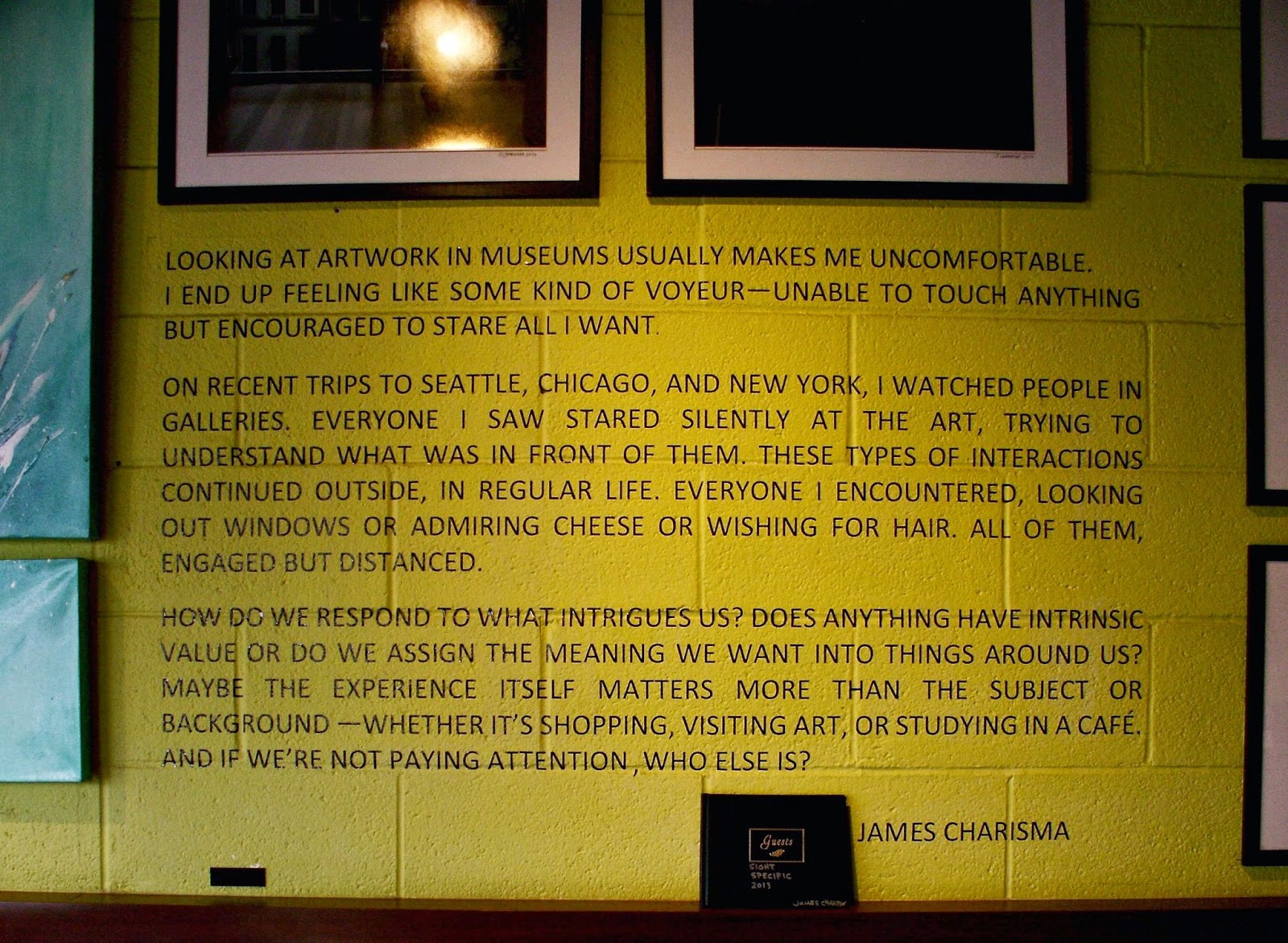
Enjoy some deep thoughts by James Charisma. 

Feeling powerless? Glazer's Coffee has a whimsical way of marking the locations of power outlets throughout the bar. That and the free WIFI makes this coffee lover's hub very popular with college students and business professionals like Yours Truly. 


Not quite a Tower of Power but, yes, plug in your laptop at no extra charge. 

I do not think we were here more than a half-hour before I noted that almost every chair in Glazer's was taken. These are college students on a Saturday morning! We thought they slept in on weekends; we did in our day. You know what they say about those who awaken early in the morning: they are the future leaders of the world! I laughed and remarked to Bill that we could be sitting with a future head of industry or a world leader. Bill shrugged and continued scanning his newspaper. 


I hereby pronounced myself a caffeinated happy camper with my official Glazer's coffee mug in hand. Yes, I have been converted. Since my first Saturday morning visit in January 2015 I've returned to Glazer's on Saturday mornings and even on weekdays, when the shop opens at 7:00 a.m. 


My Saturday morning at Glazer's Coffee was pleasant. Duty called me away for the
remainder of the afternoon -but I will be back to Glazer's Coffee. Perhaps I'll see you here? 


Located at 2700 South King Street in the Moiiliili section of Honolulu, Glazer's Coffee is open Monday through Thursday from 7:00 a.m. to 11:00 p.m., Fridays 7:00 a.m. to 9:00 p.m., and Saturday and Sunday 8:00 a.m. to 11:00p.m.  Parking is a bit limited since it is in the shared lot with Sushi King. There is a conveniently located City Bus stop down the street if you are coming from East Oahu, and another across the street if coming from Waikiki or Downtown. 


Wednesday, April 8, 2015

Makiki Christian Church Hawaii: God's Protecting Care, Inspired by Old Japan

"For the name of the Lord is a strong tower." Proverbs 18:10.


"The most successful churches, chapels, temples, synagogues, and mosques have at least one thing in common: architecture that transforms raw, earthly materials into compositions so powerful they evoke something beyond our world," wrote Tim McKeough of Architectural Digest.  History has been the witness to the creation of some of the most splendid architectural achievements. That is especially true when it comes to churches and other sacred spaces in Hawaii. 

Back in the early 20th century those associated with the Pan-Pacific Movement viewed Hawaii as the 'Crossroads of the Pacific,' with particular emphasis on the then-territory's multiethnic harmony. Those sentiments found expression in the building of the church.


When many people encounter a revered masterpiece like Makiki Christian Church in Honolulu for the first time it takes your breath away. Its five-story tall tower commandingly makes a unique statement on the city's skyline. 

Completed in 1932, it is the only church in the USA whose design was inspired by Edo-era castles in Japan. 

Yes, the church is listed on the National Register of Historic Places -deservedly so. It's also listed here with Historic Hawaii Foundation. 


That's not all that makes this church so unique and alluring. 

Believe it or not, the church edifice cost US$41,000 to build -bearing in mind that is circa 1932 dollars. It is constructed of imported redwood and took about seven months to build. 

All was not smooth-sailing when the proposed design of Makiki Christian Church was unveiled. There was great turmoil and warfare in the world of the 1930's. So, it is understandable that at least initially the board of the Hawaiian Evangelical Association had some raised eyebrows.

As you will learn shortly -as I did- that the church's first minister was both teacher and historian, persuading the board of the wisdom of adopting this design. 

In those days there was tremendous animosity between Japan -then a military-run, expansionist empire- and China. All the building materials for Makiki Christian Church were purchased from City Mill, whose president at that time was K.A. Chung. This was done on purpose to show the world that such animosities did not include the Chinese American and Japanese American communities in Hawaii. 

According to a July 13, 1932 story in the Honolulu Star Bulletin, T. Takahashi was the contractor with 35 men employed. The architect was none other than Hego Fuchino, who is recognized today as Hawaii's first Japanese American architect. 

It turns out that much of the early Japanese-inspired architectural traditions in Honolulu were all due to this self-taught designer. 

Below is his architectural rendering of the church. (Source here).


So, who was Hego Fuchino? Born in 1888 in Saga, a prefecture on the northwestern side of Kyushu, Japan, he arrived in Hawaii at around 17 or 18 years of age.  

Now, pause for a moment. Take a look at the color images of the church I've provided and the architectural rendering above, then remember this: 

Hego Fuchino worked his way through Iolani School and the University of Hawaii. 

How? 

He had a job setting up pins in a bowling alley. Not sure what that means? Try this:


That same man became the first Issei (first generation Japanese) engineer trained in Hawaii, too. Not too bad at all. 

It pays to keep your "eye on the prize," wouldn't you agree? I'll bet he never complained, too. 

Fuchino would later graduate from the University of Hawaii with a degree in civil engineering. He found employment as a land surveyor, allowing him to earn the income required to open his own engineering office. 

It was reportedly during this period of his life that he taught himself architecture. 

There is no doubt that the December 7, 1941 attack on Pearl Harbor by forces of the Empire of Japan was traumatic. Hawaii was placed under martial law, the only place in the USA where this was so. 

Not long after the attack, Fuchino was arrested upon returning to his home. His "crime"? Simply being who he was -a first-generation Japanese American. He would spend five years in various internment camps in Wisconsin (Yes, that makes my blood boil) until permitted to return to Honolulu and his practice as an architect and an engineer.


Two golden dolphins ornament the uppermost ridgepole. 


Eight years had flown by since I last visited Makiki Christian Church. The church was full of boisterous festive people as I recall.

Today I would explore this sacred place alone and in quietude. 

When I arrived to visit the church and strolled around its exterior I was very warmly greeted -nothing but bright smiles and kindness from the staff. They all knew Gloria well and asked me to send their aloha and regards. 

It was time to go in for my reunion with this sacred space. 

Yes, that immense door is as heavy as it looks. No, the church staff conducted me directly from the office. 


This is the church's entrance. Yes, those rather massive solid wooden doors are fourteen feet tall.


I stepped into a different world. Yes, I was in the right place. 

So, by now you've probably concluded that the architectural design of this church constitutes the largest volume of questions. I hear you. 

Just as that is the case in the 21st century so, too, was Makiki Christian Church the object of such questions. 

In a published news article dated October 29, 1932 a reporter named Leslie Nakashima came to the rescue back in the day. She came to mine, too, in 2015 via microfiche newspaper records. 


Welcome to the vestibule. It is one of the largest I've ever explored.  Soaring thirty feet high, the vestibule provides access to the church sanctuary and the Parish Hall. The floors here and throughout the church are of acid-stained concrete. 


"Resembling as it does a feudal castle of old Japan," wrote Nakashima, "the Rev. Takie Okumura has decided to explain."

Thank goodness! 

"We find in the Bible many passages which speak of 'God as our castle' and of 'God as high tower,'" Rev. Okumura said.


"The castle stands for grandeur and security. Man frequently sought protection of it in times of danger. It was their sole means of defense against their enemies."

"The early Christians used the castle and high tower as symbols of God's protecting care," Rev. Okumura is quoted as saying. 

So, Leslie Nakashima and Rev. Okumura accurately remind us that the biblical words inspired the congregation to build this remarkable sanctuary as we see it today.

That prompted the question as to why a Japanese Edo-era style castle design was appropriated. The answer, according to Rev. Okumura, lies in the recesses of Japanese history. 


"Of the types of Japanese architecture, the castle is the oldest and has an intimate relationship with Christianity. Tenshukaku, or high tower in the Japanese castle was the first place used for worship of the Christian God, said Rev. Okumura. 

"Therefore, we believed the castle the most appropriate design for a Japanese church edifice," he continued. "We want to Christianize the architectural beauty of Japan, offering it at the same time as a contribution of the community." 


Note the columns with the Japanese-style elbow brackets. 


According to Nakashima's piece, Rev. Okumura observed that the castles that remain in Japan today are of recent construction, and that what there was in Edo-period Japan lacked high towers, moats or stone walls. Here's something else that is new to me: the first imposing, notable castles that survived then as today were built by Lord Hisahide Matsunaga -a Christian- in November, 1560, or the 3rd era of Eiroku, at Shikisan, Yamamoto, according to Rev. Okumura. 

He told Ms. Nakashima about a five-storied tower called Tenshukaku. Ten meant Heaven, shu meant Lord, and kaku meant place, so when taken together it translates to Place to Worship Lord of Heaven. Lord Matsunaga worshiped Tenshu, or the Christian God. It literally all adds up. 

Rev. Okumura told the story of Nobunaga Oda who, in 1568, followed the instructions of Yoshioki Ashinaga. Who was he? None other than the Shogun, or military ruler of Japan. Oda invited two Catholic missionaries from the southernmost island of Kyushu to Kyoto. It was there that Lord Oda encouraged them to construct a Christian cathedral that was called Nambanji. It was located in Shijo, Kyoto. In January, 1577 Lord Oda completed the construction of Adzuchijo with a seven-story tower that mimicked Lord Hisahide's castle. 


Fast forward to the dawning years of the 20th century in Hawaii. Starting out with 24 members, the Makiki church was organized on April 8, 1904. 

Believe it or not they started off rather humbly with a shed off Kinau Street. It accommodated 36 people. 

Less than a year later, the congregation grew quickly. A cottage nearby was rented, allowing the congregation to fit up to 80 worshippers. They moved again in 1906. 

By the tenth anniversary of the founding of the Makiki church in 1914 membership had grown to 500. In 1932 it was just shy of 800 people. 

It was in 1929 -the 25th anniversary of the congregation's founding- that plans for the larger edifice we see and revere today were set in motion. Hawaii's ecclesiastical architectural landscape would never be the same. 


Welcome to the main sanctuary of Makiki Christian Church. The ceiling is 30 feet high from where I was standing. I was alone. Aside from the sounds of children playing in the Preschool courtyard there was not a sound. There is a different feel to settings like this when one is alone. There is a oneness with God, very subtly felt, yet nevertheless a larger, austere presence. 


Can you imagine the genius behind these architectural drawings, by someone who was self-taught? The church, the drawings, the inspiration behind embracing Edo-style Japanese architecture? For me these were tantalizing and yet pleasing surprises. 


This is a view of the chancel of the church from the nave. 

I had so many questions for Hego Fuchino. To think that this visionary would within ten years be arrested, hauled off to Wisconsin to an internment camp and then allowed to return. I wondered what emotions he felt returning after the war to his beloved Makiki Christian Church. 


Yes. I heard you.

Those ceiling panels did catch my attention. 


The is my view of the nave of the main sanctuary from the chancel. Beautiful. Austere, but not grim or sterile. I've always admired the Japanese for that culture's propensity towards reconciling the minimalism with the complex, the mysterious and wondrousness of faith journeys. 


According to one historical source, there are 164 ceiling panels. Each is hand-painted. They were all donated to the church by one Yunosuke Itow, "who studied art in England, France and Germany."

I have found nothing about his background. There was a famous Japanese actor by the same name, but I am not certain they are the same souls. 


The panels in the lobby area are, I have read, illustrative of well-known Japanese poems (haiku) and proverbs. 

One source I consulted carried this admonition: "In a melon patch, do not tie your shoelaces" (lest you be mistaken for a melon thief).

Another: "In a pear orchard, do not raise your hand to your hat," (lest you be mistaken for a pear thief)." 

Featured above and below are some of the ceiling panel styles. They are remarkable for their detailing. Their messages? Fascinating to contemplate. Looking for a catalyst for initiating conversation? Just look up. 


My time here seemed to fly by quickly. Rev. Okumura's presence seemed to be everywhere. In this sanctuary I found a new and rewarding avenue to Peace, to God, to Christ. 


In a time when people and congregations were segregated according to race and ethnicity, Rev. Okumura saw the future in this place and beyond, a place where all could gather under one roof to serve the Good Lord to the best of their ability. Today that dream has come to fruition -and we are better for it. 

I stayed for a few moments of smiles and conversation with church members and staff. I promised not to wait more eight years to return here. I recommend a visit, including Sunday workshop, for you, too. 


God our creator
Smiles jubilation always
Steadfast aloha.