Welcome to my world!

Welcome to my world!
Showing posts with label Greenwich Historical Society. Show all posts

Monday, October 27, 2014

A Genuine Case of Autumn at the Greenwich Historical Society's Fall Festival

It was love at first sight when I arrived at the Greenwich Historical Society's 
Fall Festival and Scarecrow Competition. 

Oh, to be home for autumn -and what timing, too! 

The skies that Sunday morning were balmy and blue. With hardly a cloud in sight, I arrived at the Greenwich Historical Society's Bush Holley House campus. The Society was holding its Fall Festival and Scarecrow Competition. 

I could not have imagined a more perfect day to savor the season's textured flavors, so rich in golds, reds and yellows that the New England states here in the USA are renowned for. 


One of the truths I hold to be self-evident is that Halloween is fun. With tinges and teases of golds and reds anticipating the coming of New England's autumn foliage displays, it is all a reminder that ours is a special and pretty place. 


History and autumnal authenticity provided families with a festive time at 
Greenwich's historic Bush Holley House. 

What is it that is so special about autumn festivals here in Connecticut? You'd think that as a native son I'd have a ready answer to that question. Had I been in the Asia-Pacific too long, you ask? 

One thing I have observed and learned about people in my travels is that we are much more similar than we give ourselves credit for. A lot of it has to do with tradition. Here I was in a place my family have called home for over three centuries. We were immersed in an historic setting that has stood the test of time and circumstance. The sun that day was benevolent. The trees had not yet turned color, but I could see faint tinges of red and yellow that would foreshadow the changing of the seasons. 

As I walked around the grounds, smiling and greeting families as well as old and new friends it dawned on me -again- that history is not just what was, but also what will be. Will the children and their parents reminisce about their experience that day? I suspect so.


I deemed this one the official greeter-scarecrow, who pointed us to apple cider and goodies. 

Silently grinning and comical in demeanor, we were greeted by a small battalion of scarecrows. This year's festival featured a menagerie of imaginative scarecrows all competing for first-prize in competition. These were all submitted by children in the community. To say the least I was impressed by the imaginations of the children who created these, many of whom were on hand. 


This is the first time I'd seen a Viking scarecrow. 


Such a warm smile!


Trays of seasonal goodies that mimicked the autumnal colors were very pleasing to the eye. 


These cookies were a special favorite with the children, many of whom had entered the scarecrow competition. 


These mini-cupcakes took good care of my daily chocolate fix. 


Autumn splendor. 


That's the historic Bush Holley House in the background. For years it was a boarding house for railroad workers before it became one for American Impressionist artists. Today's gathering would have fit perfectly with the "Bohemia at its best" festive atmosphere found on the back lawn and near the Victory Garden. 


This was the first Darth Vader scarecrow I had ever seen. It looks like 'The Force' is with him! 

We New Englanders are known for our patriotism and individuality. Is bold pink the new autumnal orange? Time will tell.

When I grew up here hayrides were part and parcel with any autumn festival. Sam Bridge Nursery and Greenhouses provided a vintage fire-engine red tractor and matching wagon. Young and old alike alighted aboard for a trip down Strickland Road, a marvelous stretch of historic houses in the Village of Cos Cob. 

That is one bright, red tractor! No, they would not let me drive -though I have prior experience. The hayride through the Strickland Road Historic District was a huge hit with festival attendees. 


No reservations or assigned seating! Everyone just piled in for our tour of the historic district. 


Yes, that is me flashing a Hawaiian-style 'shaka' sign, signaling to all that I was hanging 
loose and having fun. 

No first-class or business class seating here. Our docent educated and entertained us with fun facts and stories of the Strickland Road Historic District. 

The Cos Cob Historic District on Strickland Road is only minutes from the center of town and from the Metro-North Train Station. After I introduced myself to Gail, our hayward docent and guide, quickly seized upon my knowledge of the community's history. I enjoyed sharing historical stories and fun-facts about immaculate landscapes and the nearby Mill Pond, a place near and dear to our family since the 17th century. 

We were surrounded by an assortment of New England homes that represented the various moods and tastes of their original owners and those who preserve them in the 21st century. 

How blissful and delightful it was under balmy blue skies! Young and the young-at-heart took in historic settings and architectural styles. We conversed, laughed and anticipated the coming explosion of autumn foliage when bright colors and the best of Nature's portraits come alive before Winter's snowy slumber. 


This is the Captain Wilmot House, built in the early 19th century circa 1820. 

The Amos Mead Brush House is a favorite of mine. It was built in 1869 with a French-styled mansard roof and Federalist embellishments, such as the carved eagle above the front door. One of the interesting stories I heard was about a group of sisters who were performers that called this place home. 

The Judge George Brush House was built circa 1850. It serves at the Greenwich Historical Society's executive director's residence next door to Bush Holley House. 
This, of course, is the venerated Bush Holley House, headquarters of the Greenwich Historical Society. The original section on the left was built in the 17th century built by Dutch settlers whose family name was 'Bosch,' but changed to 'Bush.' It is open to the public for tours. I am a descendant of the Smith and Page families. They operated this place as a boarding and rooming house, including railroad workers. The Smith's were responsible for the tall French windows and double porches. Later this place would become the first American Impressionist art colony in the USA. It is on the National Register of Historic Places. 

I tend to think that we take for granted just how lucky we are. On the eve of the prettiest time in America's New England states, the days are mostly warm with crisp, cooler nights with twinkling stars to add magic and illumination to the night sky. Progressively shorter days trigger the turning of the leaves with various trees displaying varying colors.

Autumn here flows like the many steams and brooks that snake their courses through the hills. It is a time when there is an uncommon energy. There are multitudes of country fairs, farm stands selling fresh produce, apple picking and foliage watching. 

Don't get me wrong when I say that there is a quiet side that holds a certain appeal for me. Picture yourself meandering under blue skies, along age-old byways framed in by old homes and maples, all singing together an invisible symphony. It's further magnified by the reflections of red and golden foliage along the shoreline like a shimmering mirror. There is a stirring in the air in the smiles of one's neighbors. It is something for us that we hold auspicious and harmonious with the inevitable changing of the seasons. 

On this day we were all reminded that we could look forward to plenty of bright, sun-filled days. But as we now all too well that nothing good lasts forever. 

All in all, the Fall Festival was a golden opportunity to celebrate all that is truly best and bright in my ancestral home. 


Monday, September 8, 2014

It's Always Time to Frolic at French Farm, Greenwich, Connecticut USA

Here I am with an old friend at French Farm. Do you see a resemblance?


"You should collect only objects you like," said the late David Wierdsma of French Farm in Greenwich, "not hoping they will gain in value, because if they don't, you'll still have something you enjoy looking at."


The cottage at French Farm.

Nothing against my church family at the Second Congregational Church or its senior minister, Rev. Maxwell Grant, but on Sunday morning, September 15, 2013 my mind was elsewhere. 

It was one of those picture-postcard perfect days in mid-September. Summer had not yet let go of its welcomed warmth, yet there was a tinge of autumn in the air. 

It was the kind of day you pray for in church, and on this day God smiled and said, "Yes, let's hold off on the rain." Thank you, God. Literally. 

And it was a good thing, for that afternoon I would join hundreds at one of my home town's most bucolic and entertaining landscapes, French Farm. Growing up in backcountry Greenwich, I drove by the farm off Lake Avenue and Round Hill Road untold numbers of times -but I had never been inside.  


I am a little biased here, but I admit we do indeed have a colorful past worth exploring. 


Everyone enjoyed a frolicking good time at French Farm. The event was sponsored by the Greenwich Historical Society. 

So, when I received the news that French Farm was opened  for an event sponsored by the Greenwich Historical Society you better believe that I booked my reservation right away. 

As it turned out many people at church had done the same -including the senior minister, his wife and daughters! Who could blame them? 

The festive, cheerful balloons marked the entrance to French Farm. 


The crushed bluestone driveway bid a warm welcome. Parking was restricted along Lake Avenue outside the stonewall. I decided to use Greenwich Taxi. It was roughly an eight-minute drive from my home in town to get there. 


These oversized concrete acorns line the driveway in and out of French Farm.  They are big and they are heavy -trust me! There weren't any oversized squirrels in sight. ;)

The original owner of this cottage, the other farm buildings and the original 35 acres was Mary Billings French. All of the buildings were constructed between 1905 and 1910. Only the four-acre central area of the farm remains, though you feel as if you are in a much larger space. 

The buildings preserved today include the cottage, stable, cow barn, poultry house and greenhouse. 

Harold Van Buren Magonigle (1867-1935) was the architect of the buildings on French Farm. It turns out that he was best known for his memorial designs. These include the Liberty Memorial in Kansas City and the McKinley Memorial in Canton, Ohio, among others. He opened his own architectural firm in 1903 after working for such distinguished luminaries of the time as Calvert Vaux, Rotch & Tilden, Schnickel and Ditmars and the firm of McKim, Mead & White


French Farm was the first property in my ancestral home town to be placed on the National Register of Historic Places. 


Picnic tables and benches under umbrellas provided visitors with places to gather and enjoy the scenery. There were a large number of families with children in attendance, no doubt there to participate in the Treasure Hunt and other activities. 


These calypso drummers brought a Caribbean flair to the afternoon. 


A number of artists stationed themselves around French Farm. Visitors like me were encouraged to meet the artists and watch them at work. The Greenwich Historical Society's Bush Holley House headquarters was America's first Impressionist art colony, so scenes like this went with the territory. 


The artists were quite friendly and each represented his or her own style of artistic expression. 


Oh, how sinfully delicious of them! 


This was another space where all-or-can-eat food and beverages were served. Visitors young and old alike were welcomed to enjoy seasonal treats, tea sandwiches, and sweet and savory pastries. Beverages available included wine, beer, cider and water. The sandwiches and goodies were provided by celebrity chef John Barricelli of SoNo Baking. 


With a heavenly plateful of tempting, tasty goodies and an indisputably fresh cup of apple cider in hand I settled down. I enjoyed pleasant, engaging conversation with my fellow visitors to French Farm. 


Yes, I did enter my name. When they noticed my Hawaii address they looked at me and said,  "Delivery could be a bit problematic if you win." I replied that if I won I'd offer to come for a pick-up. ;)
  

They looked quite delicious! Healthy, too! But, alas, I did not win. But I did return to Greenwich on other business six weeks later. 


This is where the Treasure Hunt began. What makes French Farm so unique and appealing is the clever blending of art, gardening, cultural landscaping and natural history. The Treasure Hunt was designed to lead individuals and families on a self-guided tour of the farm.


Along the way, a whimsical variety of objects specifically chosen by the late David Wierdsma ornament the farm. Each of us were provided with a printed guide offering background information -mostly aimed at assisting parents in answering questions posed by their children. Every little bit helps! 


Welcome to what David Wierdsma called the Pterodactyl Tower. This is the centerpiece for 'the Ancient Forest.' It turns out that the tower was created by George Hendricks, a sculptor. The materials were salvaged from a demolished brownstone townhouse in Brooklyn, New York. On top of the tower is a "nest" of bittersweet and grapevines, mimicking a natural nest for dinosaur birds. 


Welcome to the petrified forest! These are real specimens of petrified wood. The samples featured here originated from the American Southwest and Asia. 


Well, now, this was interesting. It was also not on the Treasure Hunt list or the accompanying guide. Yet this collection was along the way. I'll leave it up to you to draw your own observations. Whimsical? Most definitely!


Yes, that is me dressed in my Sunday-best taking a selfie at the Mirrored Arch. If the materials here look identical to the ones used to construct the Pterodactyl Tower then you would be spot-on. They come from the same demolished New York brownstone. The funhouse mirror is "intended to take visitors into another realm-or simply to surprise and delight them."  


This crushed bluestone path led us to other surprises in the Treasure Hunt. 


One of the naturally beautiful aspects of the landscaping are the rich varieties of plant life that abounds here. Though not listed on the Treasure Hunt I certainly enjoyed such eye-catching specimens.


This was also not on the Treasure Hunt. No, I have no clue what they are. Not a one, but it is certainly amusing. I leave it to your imagination, something that I suspect David Wierdsma would have caused him to smile. 


Do you have an airplane propeller lying around the house or garage? Not sure what to do with it? David Wierdsma found one. Oh, yes, those are banana plants off to the right. This climate is not conducive to growing bananas. One of the farm's staff said they cut it down, dig up the stump and roots, then bring it to the greenhouse for the winter months. 


This authentic Chinese garden rock was listed on the Treasure Hunt. These are used as focal points in such gardens, and this one shared that distinction with the other objects on the property. "If a rock is richly textured with many holes and furrows and has a strangely contorted overall form, it is considered especially desirable. A rock like this one represents a mountain and symbolizes stability and endurance." 


Was his name Fido? This dog sculpture was not on the Treasure Hunt but I found it to be very appealing. 


Chickens and dog houses can go together nicely on a place like French Farm, where the imagination is the limit. 


If you did not want to go on the Treasure Hunt there were guided tours available. This horticultural tour was led by noted landscape designer Florence Bogaerts. A cultural landscape tour was also available and led by long time farm resident Jacek Nidzgorski. 


Imagine my surprise when I found out that this object was not an oversized bird cage but instead a French elevator cage! "Sited to provide a viewpoint for looking down into the meadow, it incorporates a seat where an adult and child could read together."  What an ingenious place to go to do one's homework.


This is the Clock with No Hands. The Treasure Hunt guide said that it was acquired for its appealing design. "It is a reminder that time stands still in a garden." So true!


Some like Nancy Sinatra sing, "These boots are made for walking, that's what I'm gonna do." David Wierdsma found a way to incorporate these boots into the framework of his whimsical garden design. 


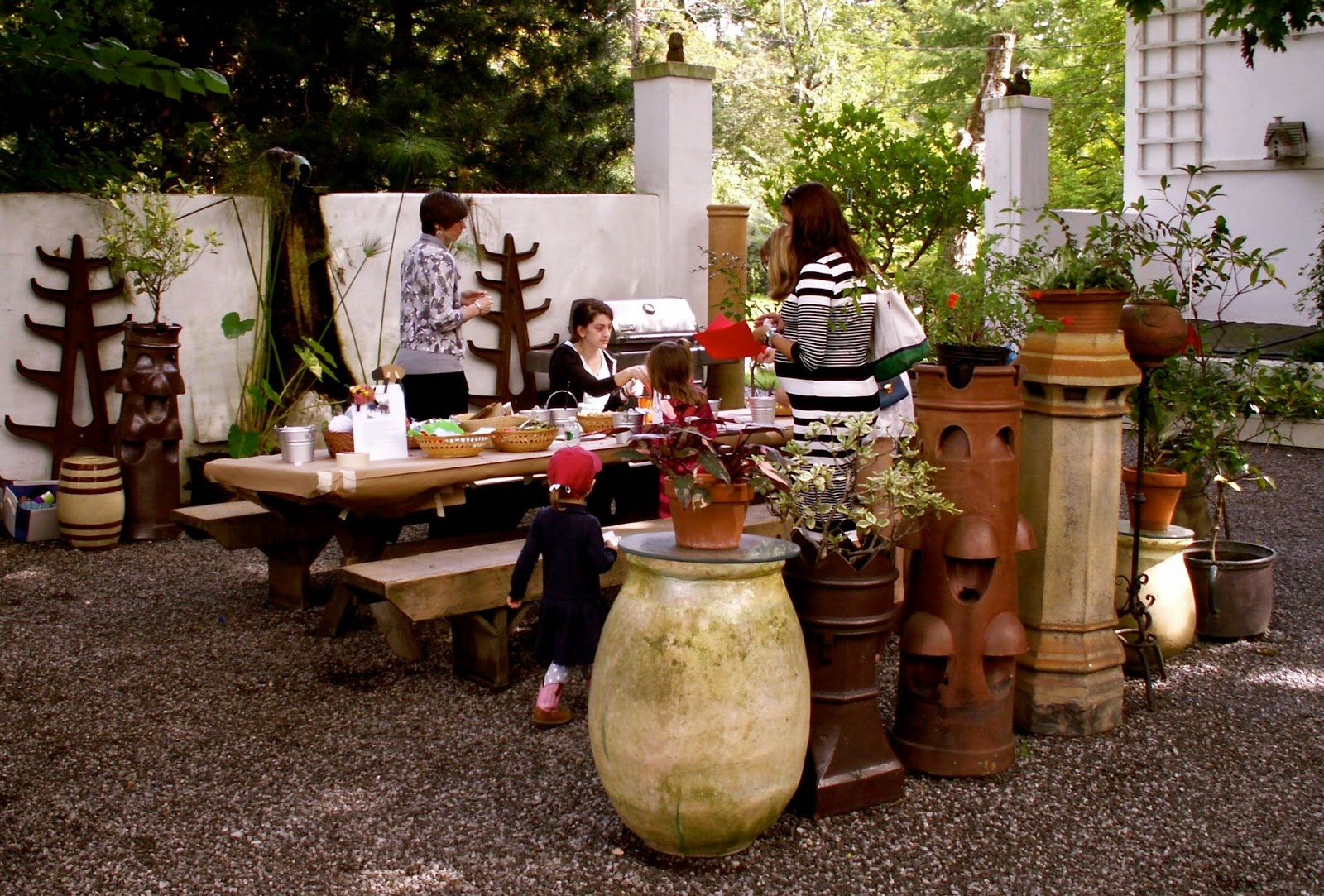
This section was set aside for children and their parents to work on their own art objects. Some of the children were so passionate and excited that they were making their mothers and fathers work overtime. 


Throughout the farm there was a rich variety of planters and clever uses for them. All were eye-catching. There was no shortage of conversation pieces at French Farm. 


The horse head is hanging on the original stable of French Farm. The wreath around it reminded me of a Connecticut version of a Hawaiian lei. 


This contemplative gargoyle was on the Treasure Hunt list. Gargoyles were used as rainspout, especially on churches in Europe. They've been used as architectural features since ancient times. Most of us associate them with medieval Europe. Some believe they frightened off evil spirits. 


This farmer statue is molded from cement and imported from Belgium. 


When I was growing up I used to collect rocks and minerals, even though science was not one of my stronger subjects. I used to collect amethyst geodes like the one -but much, much smaller. This particularly large geode is from Brazil. 


This copper shell tortoise sculpture was on the Treasure Hunt list. It's coloring emulates those of a real tortoise. 


This clot flower arrangement blended the best of summer and autumn colors. As we were approaching the final days and nights of summer it was hard not to anticipate the coming colorful foliage our region of the USA is best known for this time of the year. 


One last look at French Farm off lake Avenue, Greenwich, Connecticut. Go to this link for a TV news story. 

As all things go, good things must come to an end.

My experiences at French Farm provided me with something original, whimsical, enriching and fun. The wide array of dynamic landscapes and activities reinforced the late David Wierdsma's vision of this place so near and dear to him. It is clear that he wanted to leave a living legacy, one that would serve a crucial resource in inspiring our imaginations, stimulate our perceptions and transform the ordinary into something uncommon and interminable.

Whether it was interacting with the artists, the Treasure Hunt, the guided tours, or just plain meandering around in a late summer's afternoon, Frolic at French Farm had something for everyone of every age. It was all personal, engaging and meaningful. 

Our connection to our history, our natural surroundings and the surreal imagination and vision of one man were blended nicely together into a cohesive whole. 

French Farm is not opened to the public very often. I sure hope it is soon. 

Somehow I have the feeling that my next experience there will be as stimulating as the first. It's fun to go back for more.